
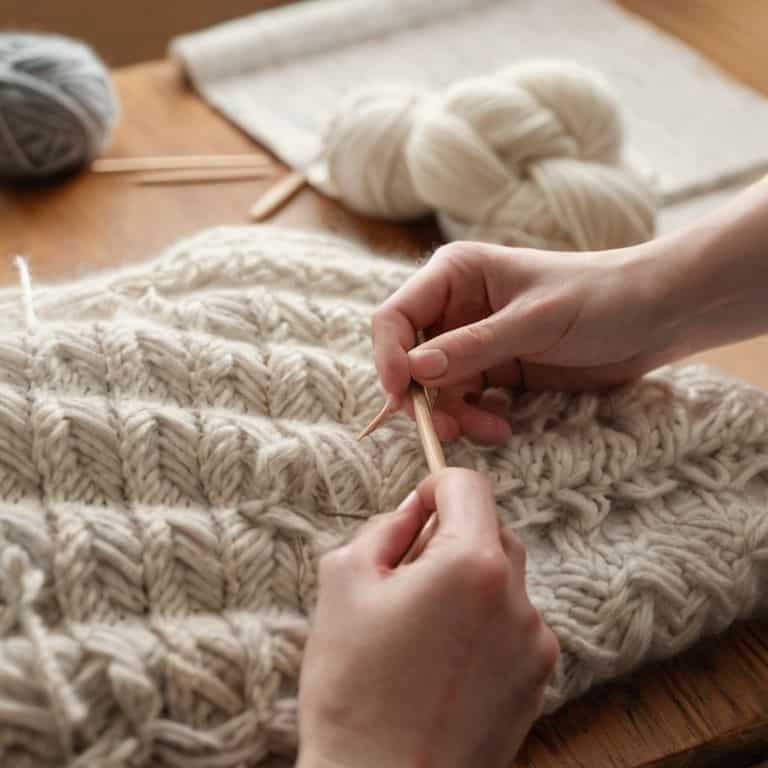
I still remember the first time I tried to read knitting patterns – it was like staring at a foreign language. I had always been fascinated by the world of knitting, but the thought of deciphering those mysterious symbols and abbreviations was daunting. As a former librarian and now a full-time craft instructor, I’ve seen many students struggle with the same issue. The common myth that you need to be a seasoned knitter to understand patterns is simply not true. With a clear and simple approach, anyone can learn how to read knitting patterns and unlock a world of creative possibilities.
In this article, I promise to guide you through the process with practical advice and step-by-step instructions. You’ll learn how to break down patterns into manageable parts, understand the terminology, and start creating your own beautiful knitted pieces. My goal is to make the process of learning how to read knitting patterns enjoyable and stress-free, so you can focus on the joy of making something with your own hands. By the end of this guide, you’ll be equipped with the confidence and skills to tackle any knitting project you desire, and I’m excited to share my knowledge with you.
Table of Contents
- Guide Overview: What You'll Need
- Step-by-Step Instructions
- Decoding Knitting Patterns
- Cracking the Code Knitting Pattern Terminology
- Navigating Charts Understanding Knitting Graphs With Ease
- 5 Essential Tips to Master Reading Knitting Patterns
- Your Key Takeaways for Reading Knitting Patterns
- A Knitter's Wisdom
- Conclusion: You're Now a Knitting Pattern Pro
- Frequently Asked Questions
Guide Overview: What You'll Need
Total Time: 1 hour 15 minutes
Estimated Cost: Free – $10
Difficulty Level: Easy
Tools Required
- Pen or pencil for writing notes
- Paper for printing or writing patterns
Supplies & Materials
- Knitting pattern can be found online or in knitting books
- Measuring tape or ruler for measuring 12 inches of knitting
- Stitch markers optional, for marking specific points in a pattern
Step-by-Step Instructions
- 1. First, let’s start by understanding the basic components of a knitting pattern. A typical pattern will include a list of materials needed, a gauge swatch to ensure your tension is correct, and a series of instructions that tell you which stitches to use and when. It’s essential to read through the entire pattern before starting to knit, so you have a clear idea of what’s involved.
- 2. Next, we need to decipher the knitting terminology used in the pattern. This can seem overwhelming at first, but don’t worry, it’s easier than you think. Start by familiarizing yourself with common knitting abbreviations, such as k for knit and p for purl. You can find a list of these abbreviations at the beginning of most patterns or online.
- 3. Now, let’s break down the pattern into smaller, manageable sections. Look for section headings, such as “Cast On” or “Body of the Sweater,” which will guide you through the different stages of the project. Within each section, you’ll find a series of instructions that tell you which stitches to use, how many rows to knit, and when to shape the fabric.
- 4. To understand the stitch instructions, you’ll need to know how to read a knitting chart. A chart is a visual representation of the stitches, showing you which stitches to knit, purl, or work in a specific pattern. Start by reading the chart from bottom to top, and from right to left. This will help you understand the sequence of stitches and how they fit together.
- 5. As you work through the pattern, it’s crucial to *keep track of your progress. You can do this by using a row counter, a sticky note, or even a mobile app. This will help you stay organized and ensure that you don’t miss any crucial steps or stitches.
- 6. When it comes to shaping the fabric, you’ll need to understand how to work increases and decreases. These are special stitches that help you add or remove stitches from your work, shaping the fabric into the desired form. Take your time when working these stitches, and make sure to count your stitches carefully to avoid any mistakes.
- 7. Finally, don’t be afraid to *ask for help if you get stuck. You can find many online resources, knitting communities, and tutorials that can guide you through tricky sections. Remember, knitting is a skill that takes time and practice to develop, so be patient with yourself and enjoy the journey.
Decoding Knitting Patterns
As we dive deeper into the world of knitting, it’s essential to understand knitting pattern terminology. This includes familiarizing yourself with common knitting abbreviations, such as “knit” (k) and “purl” (p). Having a list of these abbreviations handy can be a huge help when decoding patterns. I like to think of it as having a secret code to unlock the mysteries of knitting.
When working with complex patterns, understanding knitting charts and graphs is crucial. These visual aids can seem intimidating at first, but trust me, they’re a game-changer. By taking the time to study and understand these charts, you’ll be able to measure your knitting gauge accurately, ensuring that your finished project turns out just right. Remember, gauge is key to a well-fitting garment, so don’t skip this step.
To avoid common mistakes, it’s a good idea to review a list of tips for reading complex knitting patterns. This might include double-checking your yarn weight, needle size, and stitch count. By being mindful of these details, you’ll be able to navigate even the most complicated patterns with ease. And don’t worry if you make a mistake – it’s all part of the learning process, and you can always refer back to your notes to get back on track.
Cracking the Code Knitting Pattern Terminology
Now that we’ve dove into decoding knitting patterns, let’s talk about the terminology you’ll encounter. Knitting pattern terminology can seem like a foreign language at first, but trust me, it’s easy to learn. You’ll come across abbreviations like “kn” for knit, “purl” for purl, and “st” for stitch. Don’t worry if it seems overwhelming – with practice, you’ll be reading these abbreviations like a pro.
As we explore knitting pattern terminology, remember that it’s all about breaking it down into simple, manageable parts. I like to think of it like organizing my yarn stash using the Dewey Decimal System – everything has its place, and once you understand the system, it’s a breeze to navigate. We’ll take it one step at a time, and before you know it, you’ll be confidently reading knitting patterns and creating beautiful projects.
Navigating Charts Understanding Knitting Graphs With Ease
Now that we’ve cracked the code of knitting pattern terminology, let’s dive into navigating charts. Knitting graphs can seem intimidating at first, but trust me, they’re just a visual representation of the stitches you need to create. Think of them as a map to your knitting success. To read a chart, start by identifying the key or legend, which explains what each symbol represents. Then, work from the bottom up, reading each row from right to left. Take your time, and don’t be afraid to mark off each row as you complete it – it’s a simple trick that helps me stay on track.
As you become more comfortable with charts, you’ll begin to see the rhythm of the stitches and anticipate what comes next. Remember, it’s all about breaking it down into manageable steps. If you’re feeling overwhelmed, try highlighting or coloring in the stitches as you go – it’s a great way to visualize your progress and make the process more enjoyable. With practice, you’ll be navigating charts like a pro, and your knitting projects will become more intricate and beautiful.
5 Essential Tips to Master Reading Knitting Patterns
- Start by familiarizing yourself with basic knitting terminology to avoid confusion when encountering new words or phrases in a pattern
- Always read through the entire pattern before beginning your project to understand the overall flow and requirements
- Pay close attention to gauge information, as it is crucial for ensuring your finished project is the correct size
- Use a highlighter or colored pencil to mark important information, such as increases, decreases, or pattern repeats, to make the pattern easier to follow
- Practice, practice, practice – the more you work with knitting patterns, the more comfortable you will become with understanding the language and symbols used in them
Your Key Takeaways for Reading Knitting Patterns
Understand the basic terminology used in knitting patterns to confidently start your project
Learn to navigate knitting charts and graphs with ease by recognizing common symbols and abbreviations
Apply a step-by-step approach to decoding knitting patterns, breaking down complex instructions into manageable, foolproof tasks
A Knitter's Wisdom
The key to mastering knitting patterns lies not in memorizing complex codes, but in understanding the gentle rhythm of the stitches, and allowing each row to unfold with clarity and patience.
Beatrice "Bea" Quinn
Conclusion: You're Now a Knitting Pattern Pro
As we’ve journeyed through the world of knitting patterns together, I hope you’ve seen how breaking down the process into manageable steps can make all the difference. From decoding knitting pattern terminology to navigating charts with ease, we’ve covered the essential skills you need to confidently read and work with knitting patterns. Remember, the key to success lies in taking your time and practicing regularly – don’t be afraid to make mistakes, as they’re an integral part of the learning process.
As you move forward on your knitting adventure, keep in mind that the joy of making is just as important as the end result. Don’t be too hard on yourself if things don’t turn out as expected at first – with patience and persistence, you’ll be creating beautiful, personalized pieces in no time. So, go ahead, grab your yarn and needles, and let the magic of knitting begin – I’m honored to have been a part of your journey, and I wish you all the best on your future creative endeavors.
Frequently Asked Questions
What does it mean when a knitting pattern says 'repeat row' and how do I know when to stop?
When a pattern says ‘repeat row,’ it means you’ll knit the same row over and over. To know when to stop, look for a specific instruction, such as ‘repeat row until piece measures’ a certain length or ‘repeat row 3 more times.’ This will give you a clear endpoint for the repetition.
How can I accurately measure my gauge to ensure my finished project is the right size?
To measure gauge accurately, start by knitting a swatch that’s at least 4 inches square. Then, count the number of stitches and rows within a 4-inch area, using a ruler or measuring tape. Divide the total stitches or rows by 4 to get your gauge per inch.
What's the difference between a knit stitch and a purl stitch in a pattern, and how do I know which one to use?
Don’t worry, my friend, it’s easier than you think. A knit stitch is abbreviated as ‘k’ and a purl stitch as ‘p’. Think of it like a recipe: when a pattern says ‘k’, you’re making a knit stitch, and when it says ‘p’, you’re making a purl stitch. I like to make a little checklist to keep track of which stitches to use when – it helps me stay on track and ensures my project turns out just right.
